
15 Oldest Farmers Markets in the United States
From colonial-era town squares to iron-framed market halls, these markets have connected growers and communities for centuries - and many are still open today.
Quick Navigation
Farmers markets have brought growers, merchants, and local communities together since long before the United States became a country.
The oldest farmers markets began as open fields where farmers sold produce from wagons, while others eventually moved into permanent market houses. Many still sell fresh produce, meat, baked goods, flowers, and locally made products today. Here are 15 of the oldest farmers markets and historic public food markets still operating in the United States.
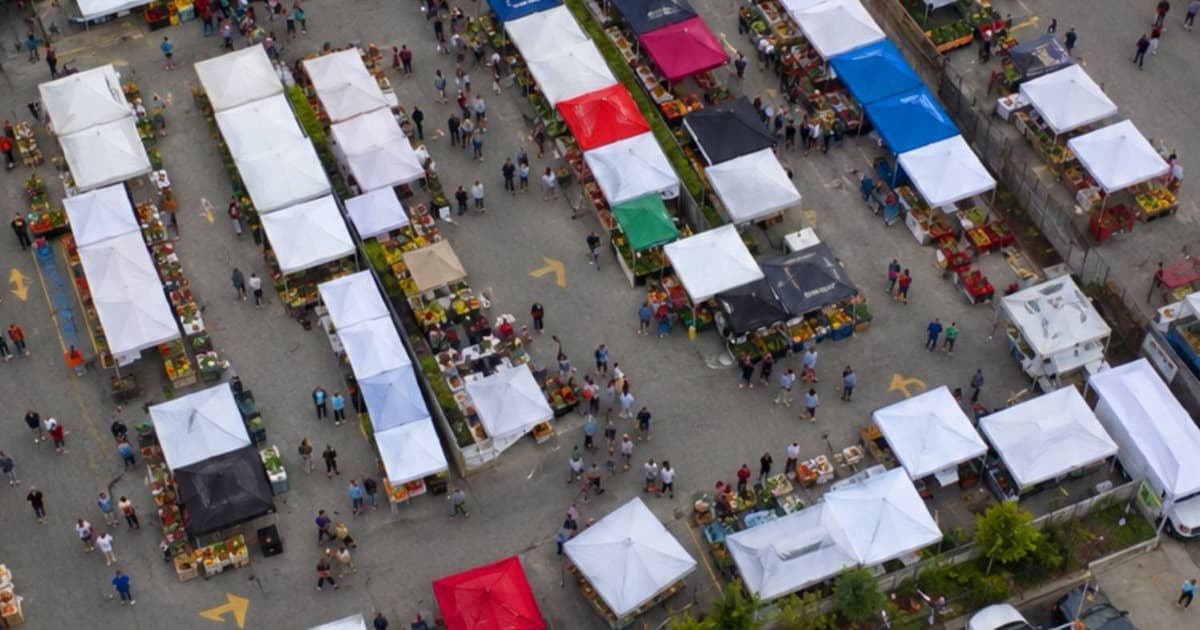

Oldest Farmers Markets in the US
1. Lancaster Central Market
Lancaster Central Market is generally recognized as the oldest continuously operating farmers market in the United States. It began in 1730, when local farmers gathered on a small plot in the center of the newly established town to sell their goods.
The market moved into its current Romanesque Revival building in 1889. Today, shoppers can browse dozens of stands offering produce, meats, cheeses, baked goods, flowers, prepared meals, and Pennsylvania Dutch specialties.
Year established: 1730
Age: 296 years
Location: Lancaster, Pennsylvania
Size: More than 65 vendors
2. Easton Farmers' Market
Established during the same year that Easton was founded, the Easton Farmers' Market calls itself the oldest continuously operating open-air market in the country. Farmers and merchants originally gathered in the city's Great Square, which is now known as Centre Square.
The producer-only market currently operates along Easton's riverfront during its regular season. Its vendors sell locally grown produce, meat, eggs, dairy products, baked goods, flowers, beverages, prepared food, and handmade products.
Year established: 1752
Age: 274 years
Location: Easton, Pennsylvania
Size: More than 70 vendors listed for the 2026 season
3. Old Town Farmers' Market
The Old Town Farmers' Market has operated in Alexandria since 1753. It is commonly recognized as the oldest farmers market in the United States to operate continuously at the same site, although it temporarily relocated across the street in 2026 while Market Square undergoes renovations.
George Washington reportedly sent produce from Mount Vernon to be sold at the market. Today, visitors can shop for fruits, vegetables, meat, cheese, bread, flowers, prepared foods, and handcrafted products.
Year established: 1753
Age: 273 years
Location: Alexandria, Virginia
Size: More than 70 vendors during peak season
4. Central Market York
York's center-city farm-to-market tradition dates back to 1754, when a royal decree permitted the town to operate a public market. The current Central Market House was built much later, opening at North Beaver and West Philadelphia streets in 1888.
The historic Romanesque Revival building remains a community gathering place filled with produce sellers, butchers, bakeries, restaurants, specialty food businesses, and local makers.
Year established: 1754 for York's market tradition; current building opened in 1888
Age: 272 years
Location: York, Pennsylvania
Size: More than 50 vendors
5. Soulard Farmers Market
Soulard Farmers Market began in 1779, when farmers gathered in a meadow south of St. Louis to sell produce, meat, cheese, and other goods. It is often described as the oldest farmers market west of the Mississippi River.
The market has occupied its current location since the 1830s. Its distinctive Grand Hall and four open-air wings now contain vendors selling produce, seafood, spices, baked goods, prepared meals, flowers, and general merchandise.
Year established: 1779
Age: 247 years
Location: St. Louis, Missouri
Size: More than 140 vendors
6. Lexington Market
Lexington Market began in 1782 as an informal gathering place where merchants exchanged goods on the outskirts of Baltimore. It later became part of Baltimore's city-owned public market system, which is recognized as the oldest public market system in the United States.
The market moved into a new building in 2022 while preserving its longtime focus on local food and independent businesses. Shoppers can find produce, seafood, meat, baked goods, groceries, prepared meals, and Baltimore favorites such as crab cakes.
Year established: 1782
Age: 244 years
Location: Baltimore, Maryland
Size: 60,000 square feet with space for more than 45 merchants
7. French Market
The French Market originated in 1791 as a trading site along the Mississippi River. Over the following centuries, Native American traders, European settlers, immigrants, farmers, fishers, and merchants all helped shape the market into one of New Orleans' most recognizable destinations.
Today, the French Market District includes restaurants, shops, public spaces, a farmers market, and a flea market. Its offerings extend far beyond farm products, but food and public commerce remain central to the market's identity.
Year established: 1791
Age: 235 years
Location: New Orleans, Louisiana
Size: Six-block market district
8. Nashville Farmers' Market
Nashville authorized the construction of its first city market house in 1801, and the 40-foot building was completed the following year. Farmers originally traveled into the city by horse and wagon to sell meat, dairy products, produce, and other farm goods.
The modern Nashville Farmers' Market includes covered farm sheds, restaurants, shops, and spaces for local artisans. Its producer-only farmers market operates throughout most of the year.
Year established: 1801
Age: 225 years
Location: Nashville, Tennessee
Size: Approximately 16 acres
9. Charleston City Market
Charleston City Market dates to 1804, when the first vendor sheds were constructed on land reserved for use as a public market. The original sheds housed sellers offering meat, vegetables, fish, and other everyday necessities.
The market has since evolved into a major shopping destination with a strong focus on handmade goods, souvenirs, and local crafts. Sweetgrass basket makers are among its best-known vendors, continuing a Lowcountry tradition passed down through generations.
Year established: 1804
Age: 222 years
Location: Charleston, South Carolina
Size: Four city blocks with more than 300 merchants
10. Haymarket
Open-air selling has taken place in this part of Boston for centuries, while the modern Haymarket tradition is generally traced to 1820. Farmers, pushcart vendors, and immigrants have long used the area to sell affordable produce, meat, fish, dairy products, and flowers.
Haymarket remains an outdoor market rather than a polished indoor food hall. Vendors set up along Blackstone Street each week, continuing a style of street commerce that has largely disappeared from other American cities.
Year established: 1820
Age: 206 years
Location: Boston, Massachusetts
Size: More than 40 independent vendors
11. West Side Market
The West Side Market traces its roots to Cleveland's Pearl Street Market, which began operating across the street from the current building in 1840. The present market house opened in 1912 and is now one of Cleveland's most recognizable landmarks.
Its large indoor hall was originally designed for sellers of meat, bread, dairy products, groceries, and specialty foods. Produce vendors were later added to the outdoor arcade surrounding the main building.
Year established: 1840 for the Pearl Street Market predecessor; current building opened in 1912
Age: 186 years from the original market
Location: Cleveland, Ohio
Size: Main market hall measures approximately 241 by 124 feet
12. Eastern Market
Detroit's public farmers market began in Cadillac Square in 1841. It moved to its present location in 1891, where it became the center of a much larger food and wholesale district known as Eastern Market.
The Saturday Market attracts farmers, food businesses, flower growers, makers, and shoppers from throughout southeastern Michigan. The surrounding district also contains wholesalers, restaurants, specialty stores, and food-production businesses.
Year established: 1841
Age: 185 years
Location: Detroit, Michigan
Size: Approximately 43 acres
13. Findlay Market
Findlay Market opened in Cincinnati in 1852 and is recognized as Ohio's oldest continuously operated public market. Its iron-framed market building is also one of the relatively few surviving public market structures from the 19th century.
The indoor market operates throughout the week with permanent merchants selling meat, seafood, produce, cheese, baked goods, prepared food, and specialty products. Additional farmers and outdoor vendors join the market on weekends.
Year established: 1852
Age: 174 years
Location: Cincinnati, Ohio
Size: More than 50 full-time merchants, plus weekend farmers and outdoor vendors
14. City Market
Kansas City's City Market dates back to 1857, when it served as a gathering place for farmers, merchants, horse traders, political speakers, and traveling entertainers. It has since become one of the largest and longest-running public farmers markets in the Midwest.
The market is open throughout the year and combines a weekend farmers market with permanent restaurants, specialty grocers, produce stands, shops, and other independently owned businesses. Farmers market vendors set up beneath three covered sheds in the center of the property.
Year established: 1857
Age: 169 years
Location: Kansas City, Missouri
Size: More than 160 stalls and 30 full-time merchants
15. Historic Roanoke City Market
The Historic Roanoke City Market began in 1882, when the city issued licenses to 25 local vendors who were then commonly called "hucksters." It is recognized as the oldest continuously operating open-air market in Virginia.
The year-round market remains an important part of downtown Roanoke. Farmers and artisans sell locally grown produce, flowers, plants, meats, cheeses, baked goods, and handmade products from permanent tables and temporary spaces around Market Square.
Year established: 1882
Age: 144 years
Location: Roanoke, Virginia
Size: 42 permanent market stalls, plus additional tent spaces
From Lancaster's 1730 town square to Roanoke's 1882 huckster stalls, these markets have outlasted wars, relocations, and entire economic eras by adapting to what their communities need while keeping local growers and makers at the center. If you're running a market today, the same fundamentals that kept these markets going for centuries - a strong location, a trustworthy vendor community, and a compelling reason to show up week after week - are still what matters most.